
Chemical kinetics
Branch of physical chemistry studying chemical reaction rates.

Wikimedia Commons · Public domain
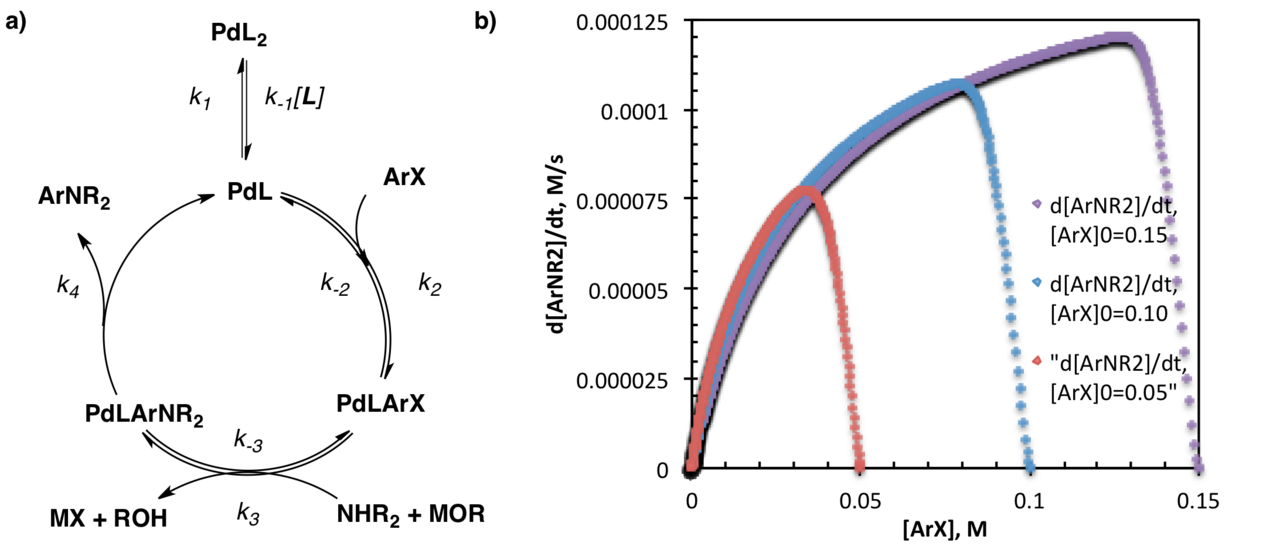
Chemical kinetics, also known as reaction kinetics, is the branch of physical chemistry concerned with understanding the rates of chemical reactions. It differs from chemical thermodynamics, which addresses reaction direction but not speed. The field investigates how experimental conditions influence reaction rates, yielding information about reaction mechanisms and transition states, and involves constructing mathematical models to describe reaction characteristics.
- field
- Physical chemistry
- known_for
- Study of reaction rates, mechanisms, and mathematical modeling
- key_contributors
- Ludwig Wilhelmy, Peter Waage, Cato Guldberg, Jacobus Henricus van 't Hoff
Lore & Background
His work was noticed 34 years later by Wilhelm Ostwald.
Reader's Guide
Chemical kinetics is significant because it provides the framework for understanding how fast reactions occur and what factors influence their speed, such as concentration, temperature, physical state, and catalysts. It distinguishes itself from thermodynamics by focusing on rates rather than equilibrium. The field has evolved through three eras: the van 't Hoff wave linking kinetics to thermodynamics, the Semenov-Hinshelwood wave emphasizing reaction mechanisms and chain reactions, and the Aris wave focusing on detailed mathematical description of reaction networks. Its practical applications range from industrial synthesis to understanding biological processes, and it remains essential for predicting reaction behavior under various conditions.
Did You Know?
- The history of chemical kinetics is often traced through key milestones: Svante Arrhenius's development of the Arrhenius equation, building on earlier work by Jacobus van 't Hoff, and the development of chain reaction th
Gallery
Frequently Asked Questions
Who is Chemical kinetics?
Chemical kinetics is a branch of physical chemistry focused on measuring and explaining how fast chemical reactions proceed. It occupies a distinct niche from thermodynamics, which tells you the direction a reaction will take but says nothing about its speed.
What are Chemical kinetics's powers or role?
Its core ability is probing how changes in experimental conditions alter reaction rates, thereby exposing the step-by-step mechanisms and transition states hidden behind each transformation. It also constructs mathematical models that capture the full kinetic profile of a reaction.
How does Chemical kinetics's story end in the Fundamentals arc?
Across episodes 25 through 28, the narrative builds from simple rate observations to full mathematical modeling of reaction behavior. It closes by handing its insights to applied domains such as catalysis, industrial process design, and biological pathway analysis.
Why is Chemical kinetics important?
Thermodynamics can tell you a reaction is favorable, but only kinetics reveals whether it will finish in a blink or take millennia. That timing information is what makes safe reactors, efficient pharmaceuticals, and viable industrial processes possible.
Who are Chemical kinetics's key allies?
Its foundational contributors include Ludwig Wilhelmy, Peter Waage, Cato Guldberg, and Jacobus Henricus van 't Hoff, whose 19th-century work established the rate laws and equilibrium-kinetics framework the field still builds on today.
More in Chemistry Fundamentals 25-28
Elsewhere in the Chemistry Fundamentals universe
Spotted an error? Know more?
This is a living reference — every entry is fact-audited, and reader corrections feed straight into our audit queue. Suggest an edit · See this site's audit record