
Chemical formula
A notation showing atomic proportions in a compound.
A chemical formula uses element symbols, numbers, and typographic marks like parentheses, dashes, brackets, commas, plus and minus signs to show the atomic proportions in a compound or molecule. It fits on a single line, with subscripts and superscripts allowed. Unlike a chemical name, it contains no words. While it can hint at simple structures, it is not a full structural formula.
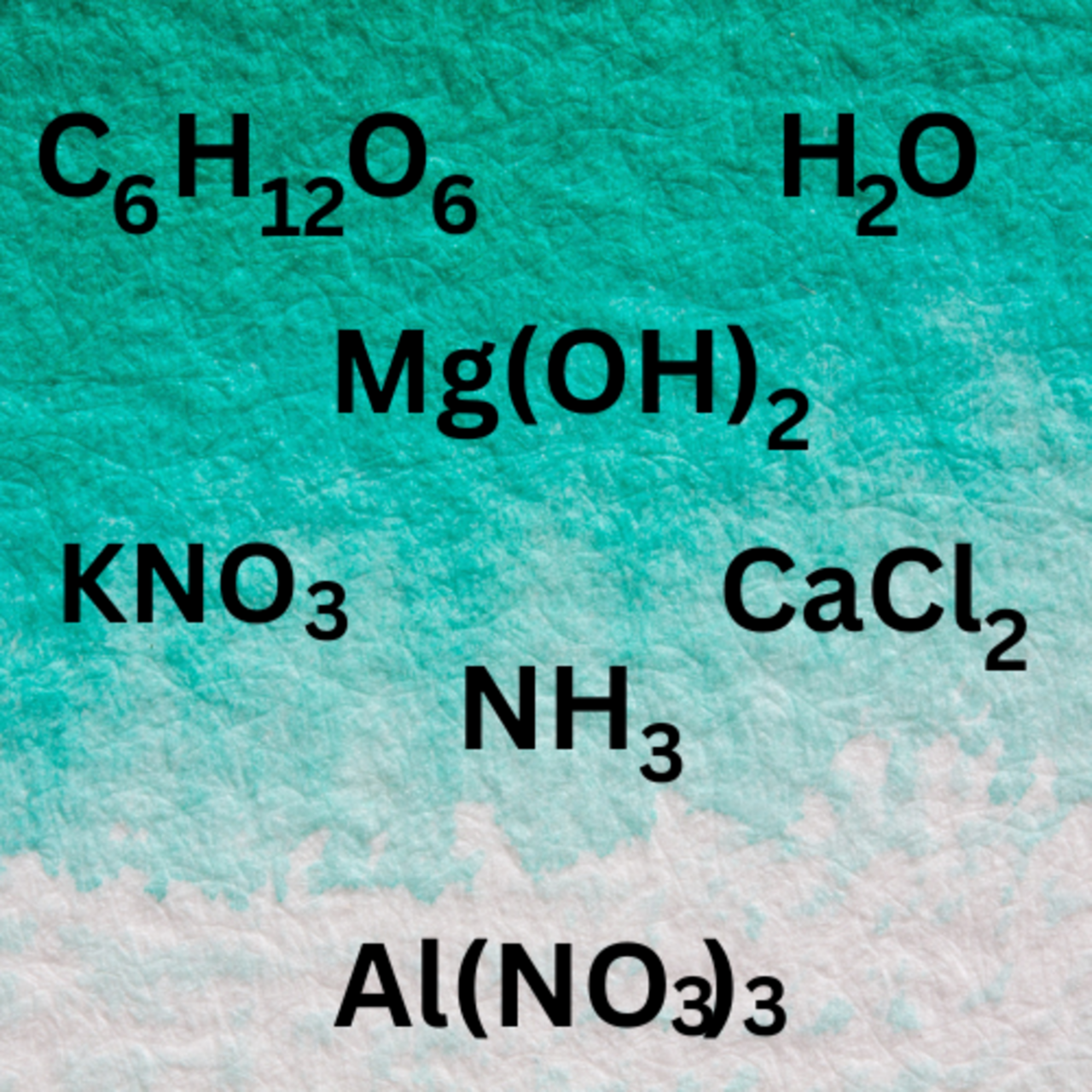
The most basic type is the empirical formula, which uses letters and numbers to show the ratio of each type of atom. A molecular formula gives the exact count of each atom in a molecule, without structural details. For instance, glucose has the empirical formula CH₂O (twice as many hydrogen atoms as carbon and oxygen) and the molecular formula C₆H₁₂O₆ (six carbon, twelve hydrogen, and six oxygen atoms).
A condensed formula, sometimes called a semi-structural formula, adds information about how atoms are bonded—covalently, ionically, or in combination—if that bonding can be shown in one dimension. Ethanol, for example, can be written as CH₃−CH₂−OH or CH₃CH₂OH. However, even condensed formulas struggle to depict complex bonding, especially for atoms bonded to four or more different groups.
Because a chemical formula must be a single line of symbols, it is less informative than a graphical structural formula, which shows spatial relationships between atoms. A single condensed formula can correspond to different molecules, called isomers. Glucose shares its molecular formula C₆H₁₂O₆ with other sugars like fructose, galactose, and mannose. Linear chemical names can uniquely specify any complex structure, but they require many words rather than simple symbols and numbers.
Chemical formulas are used in equations to describe reactions and transformations, such as dissolving ionic compounds. Though they lack the full power of structural formulas, they are sufficient to track atom counts and electrical charges, allowing equations to be balanced for conservation of atoms and charge.
Each element in a formula is identified by its chemical symbol, with the number of atoms indicated proportionally. In empirical formulas, these proportions start with a key element and assign ratios of others. For molecular compounds, these ratios are whole numbers—for example, ethanol’s empirical formula is C₂H₆O. Some ionic compounds, like boron carbide (CBₙ), have variable non-whole-number ratios, with n ranging from over 4 to more than 6.5.
For simple molecules, molecular and condensed formulas often suggest structure. A molecular formula, like C₆H₁₂O₆ for glucose, lists atom counts, but lacks structural information and can be ambiguous. Condensed formulas can fully imply a correct structure for simple compounds. Ethanol (CH₃CH₂OH) and dimethyl ether (CH₃OCH₃) share the same empirical and molecular formulas (C₂H₆O), but their condensed formulas differentiate them.
Condensed formulas also represent ionic compounds with covalently bound clusters, such as polyatomic ions like sulfate ([SO₄]²⁻). Each polyatomic ion in a compound is written separately to show the groupings. For example, dichlorine hexoxide has the empirical formula ClO₃ and molecular formula Cl₂O₆, but in liquid or solid forms, it exists as a different structure.
- type
- Notation system
- field
- Chemistry
- key_types
- Empirical, molecular, condensed (semi-structural)
- limitation
- Cannot fully specify structure except for simplest molecules
- distinction
- Distinct from chemical names and structural formulae
Lore & Background
The simplest types of chemical formulae are called empirical formulae, which use letters and numbers indicating the numerical proportions of atoms of each type. Molecular formulae indicate the simple numbers of each type of atom in a molecule, with no information on structure. For example, the empirical formula for glucose is CH2O (twice as many hydrogen atoms as carbon and oxygen), while its molecular formula is C6H12O6.
Reader's Guide
Chemical formulae are essential for describing chemical reactions and transformations in chemical equations, allowing conservation of atoms and electric charge to be tracked. However, they are limited in power compared to structural formulae or systematic chemical names. For instance, a single condensed chemical formula may correspond to different molecules known as isomers, as glucose shares its molecular formula C6H12O6 with fructose, galactose, and mannose. While empirical formulae are standard for ionic compounds and macromolecules, molecular and condensed formulae provide more information but still lack full structural detail. The distinction between chemical formulae and chemical names is important, as names like (2R,3S,4R,5R)-2,3,4,5,6-pentahydroxyhexanal can fully specify structure without graphs, whereas formulae cannot.
Did You Know?
- A chemical formula is limited to a single typographic line of symbols, which may include subscripts and superscripts.
- The empirical formula for glucose is CH2O, while its molecular formula is C6H12O6.
- Glucose shares its molecular formula C6H12O6 with other sugars including fructose, galactose, and mannose.
- Boron carbide has a variable non-whole number empirical formula of CBn, with n ranging from over 4 to more than 6.5.
Defining What an Element Is
A chemical element is fundamentally defined by a single number: the count of protons locked inside its nucleus. This count, called the atomic number, is what separates one element from every other. Oxygen, for instance, is oxygen because every one of its atoms carries exactly eight protons. Yet atoms sharing that same proton count can differ in their neutron totals, giving rise to isotopes. The term "element" also carries a second, closely related meaning in everyday chemistry: a pure substance made up of only one kind of atom, such as a sample of oxygen gas. This dual usage creates a subtle distinction that some languages handle more explicitly. French, for example, separates the concept of a kind of atom (élément chimique) from the pure substance made of those atoms (corps simple), and Russian draws a similar line between химический элемент and простое вещество. English has not fully adopted parallel terms like "elementary substance" or "simple substance," so the two meanings often blur in common parlance, even though a water molecule (H₂O) contains the elements hydrogen and oxygen without actually containing the diatomic substances H₂ or O₂.
The Periodic Table and Element Properties
The most enduring way to organize the known elements is the periodic table, a framework whose first recognizable form was published in 1869 by Russian chemist Dmitri Mendeleev. The table arranges elements in ascending order of atomic number across horizontal rows called periods, while vertical columns called groups gather elements that share recurring physical and chemical behaviors. This structure lets chemists read off a rich set of properties for each entry: atomic weight, isotopic composition, natural abundance, ionization energy, electron affinity, common oxidation states, and electronegativity. Radioactive nuclides can additionally be sorted by half-life. When elements are viewed as bulk substances rather than isolated atoms, the relevant properties shift to density, melting and boiling points, electrical conductance, and thermal conductivity. Beyond mere cataloguing, the table serves as a predictive instrument. Because elements in the same group tend to behave alike, chemists can extrapolate likely characteristics of exceedingly short-lived nuclides that have never been directly observed, and even anticipate the kinds of compounds those as-yet-unknown elements might form. The table thus functions as both a summary of what is known and a roadmap for what remains to be discovered.
Cosmic Origins and Natural Occurrence
The lightest elements—hydrogen and helium—were forged in the first twenty minutes after the Big Bang, produced in roughly a three-to-one mass ratio (twelve-to-one by atom count), accompanied by minute traces of lithium and beryllium. Virtually every other element found in nature was assembled later through various natural nucleosynthesis pathways. On Earth itself, new atoms continue to appear through nucleogenic reactions, cosmogenic processes such as cosmic-ray spallation, and the radiogenic daughter isotopes generated by ongoing radioactive decay, including alpha decay, beta decay, spontaneous fission, and cluster decay. Of the 118 elements now recognized, the first 94 have been detected directly on Earth as primordial nuclides inherited from the Solar System's formation or as natural fission and transmutation products of uranium and thorium. Six of these—technetium (43), promethium (61), astatine (85), francium (87), neptunium (93), and plutonium (94)—exist only in extreme trace quantities on our planet, though they have been identified in the spectra of stars, neutron-star mergers, and supernovae, where short-lived radioactive elements are continuously being created. The remaining 24 elements, with atomic numbers above 94, have no natural occurrence and exist solely as products of human-made nuclear reactions.
From Ancient Minerals to Oganesson
Long before the modern concept of an element existed, early human societies encountered native minerals such as carbon, sulfur, copper, and gold, and attempts to classify these materials gave rise to classical elemental theories and alchemical traditions. The practical definition that an element is a substance that cannot be decomposed into simpler substances by chemical reactions remained broadly valid for centuries. A notable controversy arose in the 1920s over whether isotopes, which could sometimes be separated by chemical means, should be counted as distinct elements. By November 2016, the International Union of Pure and Applied Chemistry (IUPAC) had formally recognized 118 elements in total. The most recent additions include element 118, named oganesson, whose synthesis was reported in October 2006, and element 117, tennessine, reported in April 2010. "Known" in this context means observed sufficiently—even from just a handful of decay products—to be distinguished from every other element. The search for still-heavier elements remains an active frontier of scientific research, while nearly all stable elements are available industrially in varying quantities, making the periodic table both a historical record and a living, expanding catalogue.
Gallery


Frequently Asked Questions
What is a Chemical formula?
A Chemical formula is a single-line notation in chemistry that combines element symbols, numerical subscripts or superscripts, and auxiliary marks like parentheses or dashes to express the relative atom counts in a compound. It functions purely as a symbolic shorthand rather than a written name, since it contains no words at all.
What are Chemical formula's powers or role?
Its core job is to communicate which elements are present in a molecule and in what proportion, letting chemists identify and compare substances at a glance. It also underpins stoichiometric calculations and reaction balancing, making it a daily workhorse in quantitative chemistry.
How does Chemical formula's story end?
Its arc hits a hard limitation: it cannot fully specify how atoms are bonded or arranged in three-dimensional space, except for the very simplest molecules. For anything more complex, chemists must reach for structural formulae to capture the full bonding picture.
Why is Chemical formula important?
It provides a universal, language-independent shorthand that lets scientists worldwide reference the same compound without lengthy verbal descriptions. Because it encodes exact atomic ratios, it also makes it straightforward to balance equations and compute molar relationships.
How is Chemical formula different from a chemical name or a structural formula?
A chemical name uses words, while a formula uses only symbols and numbers, so they occupy entirely different communicative roles. A structural formula, by contrast, draws out individual bonds and spatial arrangement, whereas a plain formula conveys proportions alone without depicting connectivity.
More in Chemistry Fundamentals 1-24
Spotted an error? Know more?
This is a living reference — every entry is fact-audited, and reader corrections feed straight into our audit queue. Suggest an edit · See this site's audit record