Acid–base reaction
A chemical reaction between an acid and a base.

Damitr · CC BY-SA 4.0
An acid–base reaction is a chemical reaction that occurs between an acid and a base. It can be used to determine pH via titration. Several theoretical frameworks, called acid–base theories, provide alternative conceptions of the reaction mechanisms, including the Brønsted–Lowry acid–base theory.
- first_proposed_by
- Guillaume-François Rouelle
- first_scientific_concept_by
- Antoine Lavoisier
- field
- Chemistry
- key_theories
- Arrhenius, Brønsted–Lowry, Lewis
Lore & Background
This definition held for over 30 years until Sir Humphry Davy proved the lack of oxygen in hydrogen sulfide, hydrogen telluride, and the hydrohalic acids. Davy concluded that acidity does not depend upon any particular elementary substance but upon peculiar arrangement of various substances. Jöns Jacob Berzelius modified the oxygen theory, stating that acids are oxides of nonmetals while bases are oxides of metals.
Reader's Guide
The Arrhenius theory, devised by Svante Arrhenius, was the first modern definition of acids and bases in molecular terms. It describes an acid as a substance that increases the concentration of hydrogen ions (H3O+ or H+) in a solution, and a base as a substance that increases the concentration of hydroxide ions (OH-) in a solution. However, this definition only applies to substances that are in water. The Brønsted–Lowry theory is a subset of the broader Lewis model, and the Arrhenius theory is the most restrictive. These theories complement each other, with the Lewis model having the broadest definition. The importance of these theories becomes apparent in analyzing acid–base reactions for gaseous or liquid species, or when acid or base character may be somewhat less apparent. The reaction of an acid with a base is called a neutralization reaction, producing a salt and water. An example is the reaction of hydrochloric acid with sodium hydroxide to produce sodium chloride and water.
Did You Know?
- Antoine Lavoisier defined acids in terms of their containing oxygen, naming oxygen from Greek words meaning 'acid-former'.
- The Arrhenius definition of acids and bases is restricted to aqueous solutions.
- Baking powder uses an acid–base reaction between sodium bicarbonate and acidic salts to produce carbon dioxide bubbles.
The Long Lineage of Acid Definitions
The concept of what constitutes an acid has evolved dramatically over more than a century of chemistry. In 1884, Svante Arrhenius first pinned acidity to the release of hydrogen cations into water, establishing that a substance increasing H+ concentration in aqueous solution qualifies as an acid. This framework, while practical, was tethered to water. In 1923, Johannes Nicolaus Brønsted and Thomas Martin Lowry independently broke free from that constraint by identifying proton transfer as the essential event, whether or not water was present. Their generalized theory could describe acetic acid donating a proton to ammonia in a non-aqueous setting, something Arrhenius's definition simply could not address. Then came the Lewis acid concept, where a species like boron trifluoride accepts an electron pair into a vacant orbital, forming a covalent bond with a base such as ammonia. Lewis viewed this as an even broader generalization, encompassing proton release as one mechanism among many. Today, unless a chemist explicitly says "Lewis acid," the word "acid" implicitly refers to the Brønsted-Lowry proton-donor sense.
Acids in the Kitchen, the Body, and the Garage
Acids are far from abstract laboratory curiosities; they permeate daily life in tangible, recognizable forms. Hydrochloric acid, a solution of hydrogen chloride gas, sits at the heart of gastric acid in the human stomach, where it activates digestive enzymes. A dilute aqueous solution of acetic acid gives vinegar its sharp, sour character. Sulfuric acid powers the lead-acid batteries in automobiles, while citric acid lends citrus fruits their characteristic tang. The very word "acid" traces back to the Latin acidus, meaning sour, a nod to the taste that has defined these substances since ancient times. Aqueous acid solutions turn blue litmus paper red, react with certain metals like calcium to produce salts, and register a pH below seven, with lower values indicating higher hydrogen cation concentration. Strong acids and some concentrated weak acids are corrosive, though notable exceptions exist, such as boric acid and carboranes. Whether encountered as a pure solid, liquid, or gas, or dissolved in solution, acids in the colloquial sense are as varied as the contexts in which we meet them.
Proton Transfer as the Central Drama
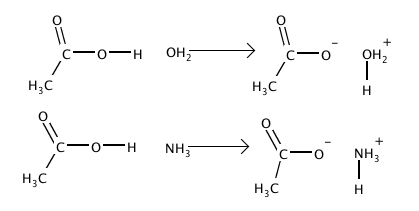
At the heart of most acid-base chemistry lies a deceptively simple event: the transfer of a proton from one species to another. The Brønsted-Lowry definition, now the most widely applied framework, casts the acid as the proton donor and the base as the acceptor. In water, this proton does not float free as a bare hydrogen nucleus; instead it exists as the hydronium ion H3O+, or in larger clusters like H5O2+ and H9O4+. When acetic acid dissolves in water, it donates a proton to a water molecule, generating acetate and hydronium. Yet the same acetic acid molecule can donate that proton to ammonia, yielding acetate and ammonium, a reaction that falls outside the Arrhenius definition because no hydronium is produced. This flexibility is precisely why Brønsted-Lowry theory extends into non-aqueous solvents and even the gas phase. Hydrogen chloride and ammonia, for instance, combine under various conditions to form ammonium chloride, a transformation the proton-transfer model captures seamlessly regardless of the medium.
Beyond Protons — The Lewis Acid Realm
Not every acid donates a proton. Lewis acids operate on a different principle entirely: they accept a pair of electrons and form a covalent bond. Boron trifluoride is a classic example. Its boron atom carries a vacant orbital, and when it encounters ammonia, the nitrogen's lone pair slots into that empty space, creating a stable covalent linkage. Lewis regarded this electron-pair acceptance as a generalization that subsumed the Brønsted concept, since a proton released into solution ultimately accepts electron pairs from a base. However, the two categories do not fully overlap. Hydrogen chloride, acetic acid, and most familiar Brønsted-Lowry acids cannot form a covalent bond with an electron pair and therefore are not Lewis acids. Conversely, many Lewis acids have no hydrogen to donate and so are not Arrhenius or Brønsted-Lowry acids at all. In modern chemical parlance, this distinction is handled by convention: the bare word "acid" almost always signals a Brønsted proton donor, while a Lewis acid must be named explicitly to avoid confusion.
Gallery



Frequently Asked Questions
What exactly is an acid–base reaction?
It is a chemical process in which an acid and a base interact and transform into new products. The reaction sits at the core of how chemists understand proton transfer and electron-pair donation in solution.
Who first introduced the idea of an acid–base reaction?
Guillaume-François Rouelle is credited with proposing the earliest notion, while Antoine Lavoisier later gave the concept its first rigorous scientific framing. Their combined groundwork laid the stage for every modern acid–base theory that followed.
Which major theories explain how acid–base reactions work?
Three principal frameworks dominate: the Arrhenius model, the Brønsted–Lowry theory, and the Lewis theory. Each offers a different lens—ranging from ion dissociation in water to proton transfer and electron-pair acceptance—so chemists can describe a wider variety of reactions.
How do chemists actually use acid–base reactions in the lab?
The most common application is titration, where a solution of known concentration is added to an unknown one until the reaction reaches its endpoint. This straightforward technique lets researchers determine the pH or concentration of a sample with high precision.
Why is the acid–base reaction considered a cornerstone of chemistry fundamentals?
It appears in everything from biological pH regulation to industrial neutralization processes, making it one of the most universally encountered reaction types. Mastering its three theoretical descriptions gives students a flexible toolkit for predicting behavior across many chemical systems.
More in Chemistry Fundamentals 1-24
Elsewhere in the Chemistry Fundamentals universe
Spotted an error? Know more?
This is a living reference — every entry is fact-audited, and reader corrections feed straight into our audit queue. Suggest an edit · See this site's audit record